

Hi
Hi
andrey deryabin
AI-Native
Logistics
Strategist
Strategist
Strategist
Identifying AI-native logistics operators before the market fully reprices them
A DIFFERENT
DILIGENCE LENS
I’m focused on identifying which logistics operators are gaining structural advantage – and which FreightTech segments are losing defensibility.
1. OPERATIONAL REPRICING
AI shifts operational cost structure
Lower costs → lower rates → higher volume → lower unit costs
AI-native logistics operators structurally outperform
2. AI-NATIVE LOGISTICS
Centralized operational communication
AI-readable workflows
AI-driven execution layers
3. FREIGHTTECH VULNERABILITY
Internal tooling becomes cheaper to build
Operational intelligence stays internal
Non-network-effect workflow SaaS loses defensibility
1. OPERATIONAL REPRICING
AI shifts operational cost structure
Lower costs → lower rates → higher volume → lower unit costs
AI-native logistics operators structurally outperform
2. AI-NATIVE LOGISTICS
Centralized operational communication
AI-readable workflows
AI-driven execution layers
3. FREIGHTTECH VULNERABILITY
Internal tooling becomes cheaper to build
Operational intelligence stays internal
Non-network-effect workflow SaaS loses defensibility
About me
I’ve worked across logistics operations and FreightTech for more than two decades – building companies and seeing firsthand where operational leverage, workflow visibility, and software defensibility succeed or fail.
More recently, I’ve focused on how AI is shifting enterprise value from workflow software vendors toward AI-native logistics operators.
5+
5+
5+
5+
Years in Logistics
2
2
2
2
FreightTech Iterations
3
3
3
3
Business Exits
WHY THIS PERSPECTIVE
EXISTS
My perspective comes from operating inside logistics for decades while simultaneously building FreightTech products and watching where software creates – or fails to create – lasting operational advantage.
1.
WHY DOES AI MATTER MORE IN LOGISTICS?
2.
WHAT DEFINES AN “AI-NATIVE” OPERATOR?
3.
WHY MAY SOME FREIGHTTECH CATEGORIES WEAKEN?
4.
WHY COULD MID-SIZED OPERATORS OFFER THE LARGEST ASYMMETRY?
5.
WHY IS THIS EASY TO MISS IN DILIGENCE?
1.
WHY DOES AI MATTER MORE IN LOGISTICS?
2.
WHAT DEFINES AN “AI-NATIVE” OPERATOR?
3.
WHY MAY SOME FREIGHTTECH CATEGORIES WEAKEN?
4.
WHY COULD MID-SIZED OPERATORS OFFER THE LARGEST ASYMMETRY?
5.
WHY IS THIS EASY TO MISS IN DILIGENCE?
1.
WHY DOES AI MATTER MORE IN LOGISTICS?
2.
WHAT DEFINES AN “AI-NATIVE” OPERATOR?
3.
WHY MAY SOME FREIGHTTECH CATEGORIES WEAKEN?
4.
WHY COULD MID-SIZED OPERATORS OFFER THE LARGEST ASYMMETRY?
5.
WHY IS THIS EASY TO MISS IN DILIGENCE?
WHAT I’M ALREADY SEEING IN LOGISTICS
Operational signals that may matter long before AI-native transition becomes obvious financially.
AI is reducing operational headcount per shipment
Operators increasingly automate quoting, communication, documentation, etc., without proportional team growth.
Internal tooling is replacing workflow SaaS
Mid-sized operators increasingly build internal operational systems instead of relying entirely on external vendors.
FreightTech defensibility is weakening
Workflow software without strong network effects may face structural pressure as AI lowers internal development cost.
AI-native operators compound faster
Lower operational costs → lower rates → higher volume → lower unit costs → structural market advantages
Operational visibility becomes strategic infrastructure
AI performance increasingly depends on centralized communication and AI-readable workflows.
Mid-sized operators may offer the largest asymmetry
Some operators already show AI-native characteristics while still being valued like traditional logistics companies.
Featured Projects
These projects come from 20+ years of entrepreneurship – shaping how I think about operational leverage, workflow visibility, software defensibility, and why some logistics operators build lasting structural advantages while others fail to adapt.
FreightTech Startup
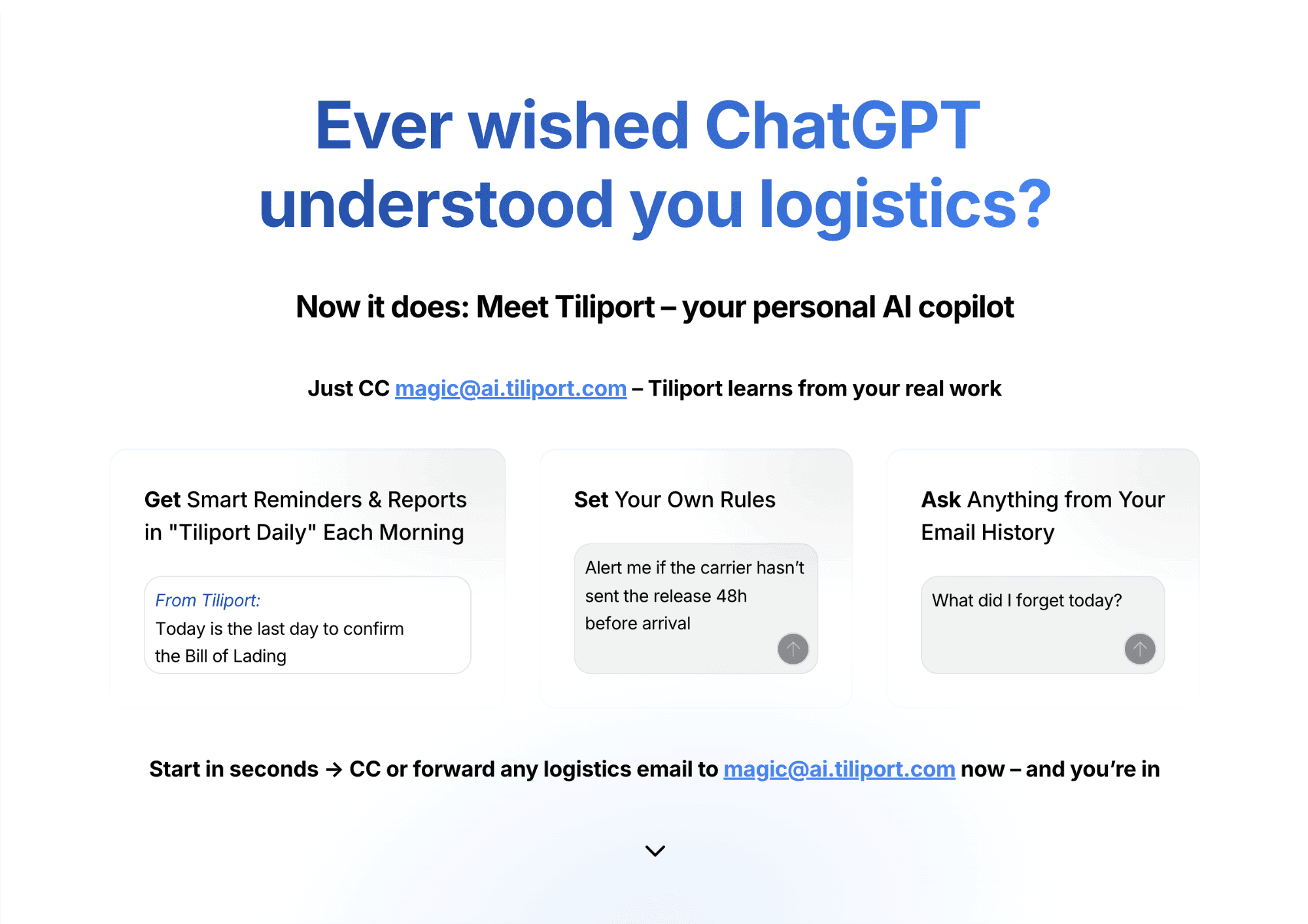
Personal ChatGPT for Logistics
We reframed Tiliport as a private, logistics-specific ChatGPT – but based on each user’s particular logistics data.
FreightTech Startup
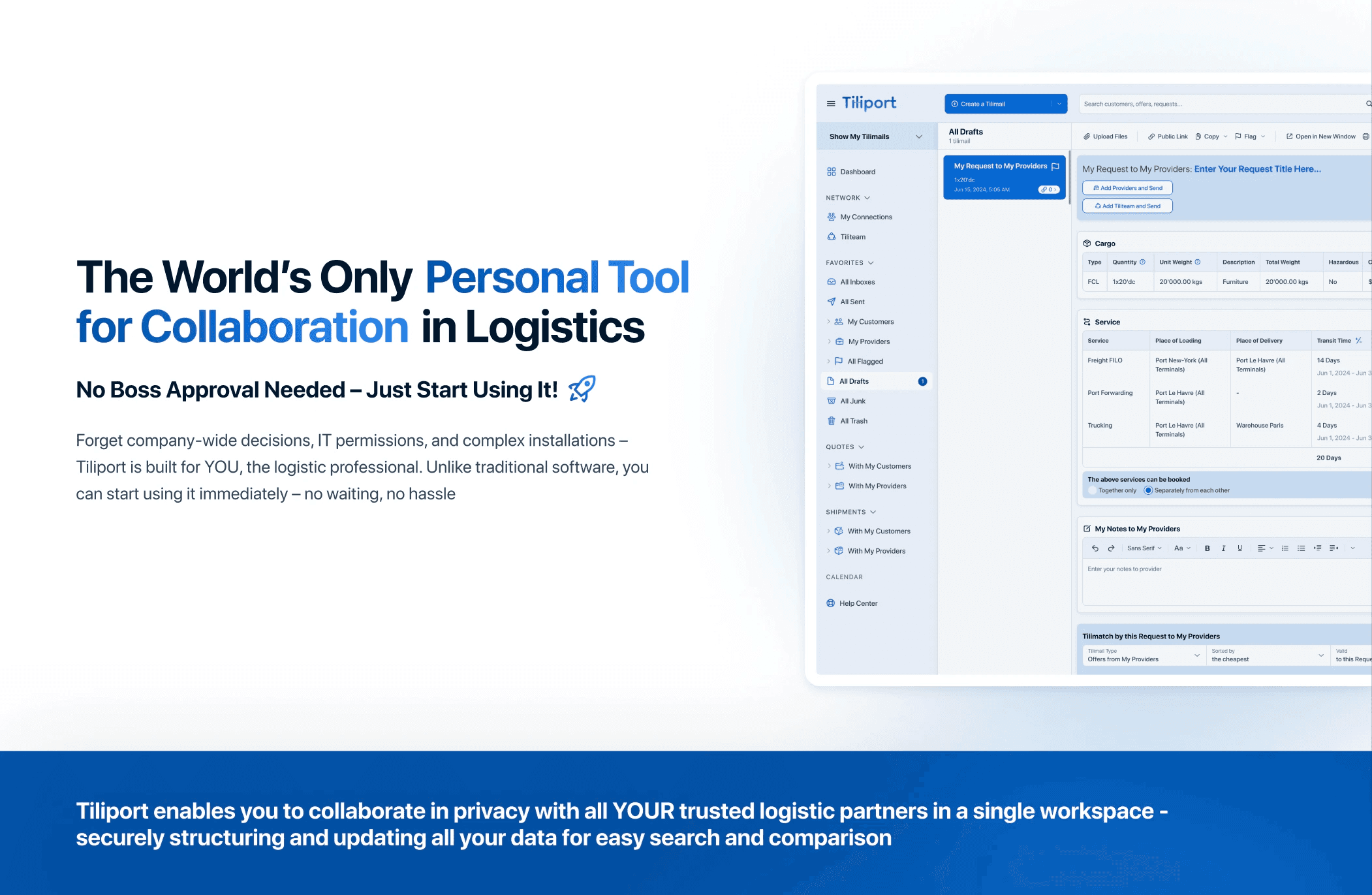
Collaborative Logistics Platform
I set out to build a new category: a cross-company logistics workspace. The idea was to replace fragmented communication across emails, messengers, and phone calls with a structured, shared system. Tiliport was designed to help freight teams – across different companies – work together like one.
FreightTech Startup
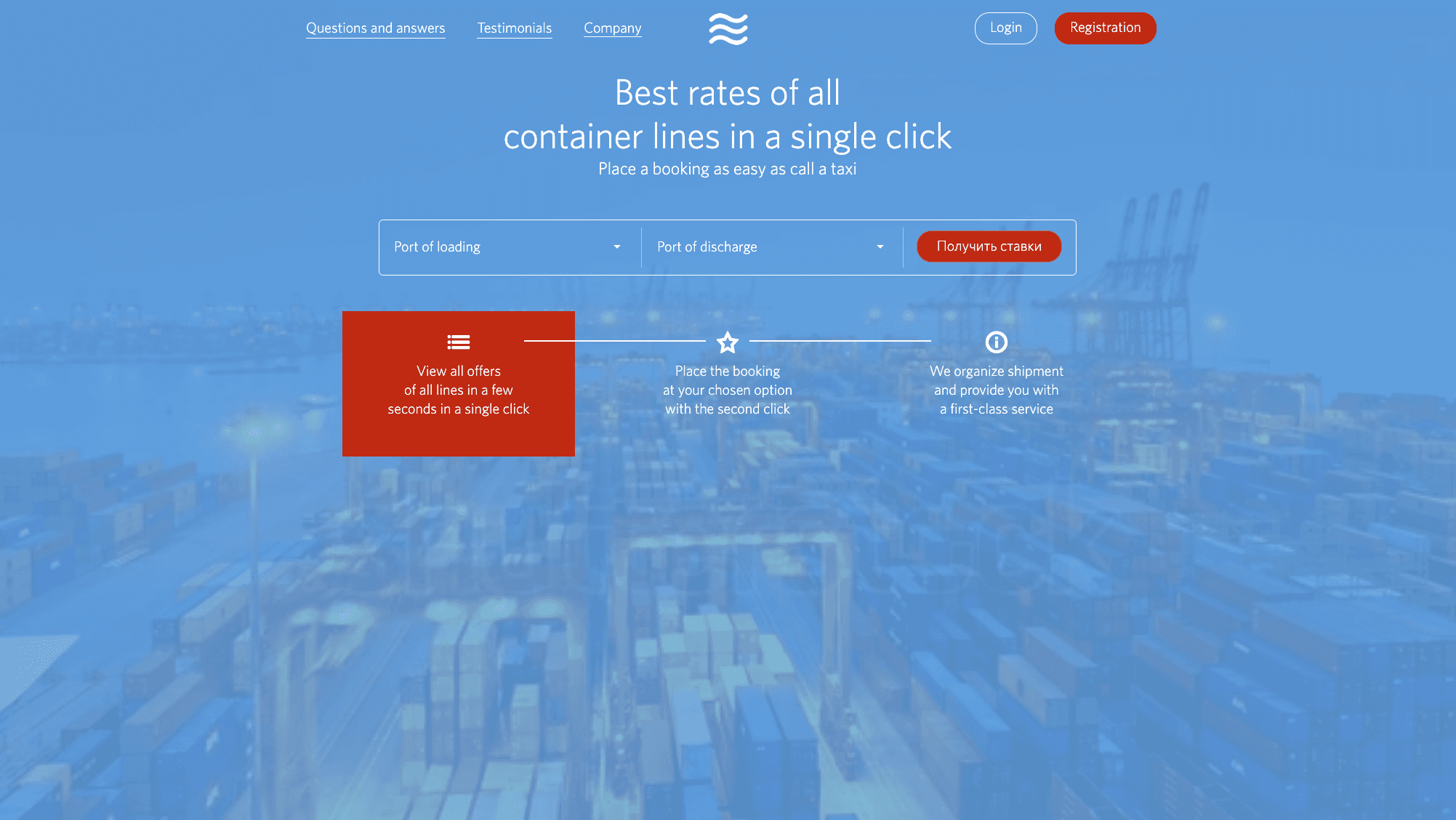
The World's Only Container Lines Aggregator
In early 2017, I launched AllContainerLines.com – the world’s first online aggregator of ocean freight rates directly from container lines. It worked like Skyscanner for ocean freight: users entered POL and POD, saw instant rates for 20’DC / 40’DC / 40’HC, and could book with one click. Unlike traditional freight forwarders, we offered no extra services – just raw port-to-port pricing, like the ocean carriers themselves.

Old School Business
Freight Forwarding Company
A full-service freight forwarding company I founded to help small and mid-sized shippers move cargo faster, with better communication and smarter use of tech. We offered international ocean, air, and ground transport, with in-house customs clearance and warehousing services, primarily serving Eastern Europe–Asia routes.

Hi
Hi
Let's talk
If you’re investing in logistics or FreightTech and thinking about how AI may reshape operational advantage, portfolio defensibility, and industry structure – I’d be glad to compare notes.
Hi
Hi
andrey deryabin
AI-Native
Logistics
Strategist
Strategist
Strategist
Identifying AI-native logistics operators before the market fully reprices them
A DIFFERENT
DILIGENCE LENS
I’m focused on identifying which logistics operators are gaining structural advantage – and which FreightTech segments are losing defensibility.
1. OPERATIONAL REPRICING
AI shifts operational cost structure
Lower costs → lower rates → higher volume → lower unit costs
AI-native logistics operators structurally outperform
2. AI-NATIVE LOGISTICS
Centralized operational communication
AI-readable workflows
AI-driven execution layers
3. FREIGHTTECH VULNERABILITY
Internal tooling becomes cheaper to build
Operational intelligence stays internal
Non-network-effect workflow SaaS loses defensibility
1. OPERATIONAL REPRICING
AI shifts operational cost structure
Lower costs → lower rates → higher volume → lower unit costs
AI-native logistics operators structurally outperform
2. AI-NATIVE LOGISTICS
Centralized operational communication
AI-readable workflows
AI-driven execution layers
3. FREIGHTTECH VULNERABILITY
Internal tooling becomes cheaper to build
Operational intelligence stays internal
Non-network-effect workflow SaaS loses defensibility
About me
I’ve worked across logistics operations and FreightTech for more than two decades – building companies and seeing firsthand where operational leverage, workflow visibility, and software defensibility succeed or fail.
More recently, I’ve focused on how AI is shifting enterprise value from workflow software vendors toward AI-native logistics operators.
5+
5+
5+
5+
Years in Logistics
2
2
2
2
FreightTech Iterations
3
3
3
3
Business Exits
WHY THIS PERSPECTIVE
EXISTS
My perspective comes from operating inside logistics for decades while simultaneously building FreightTech products and watching where software creates – or fails to create – lasting operational advantage.
1.
WHY DOES AI MATTER MORE IN LOGISTICS?
2.
WHAT DEFINES AN “AI-NATIVE” OPERATOR?
3.
WHY MAY SOME FREIGHTTECH CATEGORIES WEAKEN?
4.
WHY COULD MID-SIZED OPERATORS OFFER THE LARGEST ASYMMETRY?
5.
WHY IS THIS EASY TO MISS IN DILIGENCE?
1.
WHY DOES AI MATTER MORE IN LOGISTICS?
2.
WHAT DEFINES AN “AI-NATIVE” OPERATOR?
3.
WHY MAY SOME FREIGHTTECH CATEGORIES WEAKEN?
4.
WHY COULD MID-SIZED OPERATORS OFFER THE LARGEST ASYMMETRY?
5.
WHY IS THIS EASY TO MISS IN DILIGENCE?
1.
WHY DOES AI MATTER MORE IN LOGISTICS?
2.
WHAT DEFINES AN “AI-NATIVE” OPERATOR?
3.
WHY MAY SOME FREIGHTTECH CATEGORIES WEAKEN?
4.
WHY COULD MID-SIZED OPERATORS OFFER THE LARGEST ASYMMETRY?
5.
WHY IS THIS EASY TO MISS IN DILIGENCE?
WHAT I’M ALREADY SEEING IN LOGISTICS
Operational signals that may matter long before AI-native transition becomes obvious financially.
AI is reducing operational headcount per shipment
Operators increasingly automate quoting, communication, documentation, etc., without proportional team growth.
Internal tooling is replacing workflow SaaS
Mid-sized operators increasingly build internal operational systems instead of relying entirely on external vendors.
FreightTech defensibility is weakening
Workflow software without strong network effects may face structural pressure as AI lowers internal development cost.
AI-native operators compound faster
Lower operational costs → lower rates → higher volume → lower unit costs → structural market advantages
Operational visibility becomes strategic infrastructure
AI performance increasingly depends on centralized communication and AI-readable workflows.
Mid-sized operators may offer the largest asymmetry
Some operators already show AI-native characteristics while still being valued like traditional logistics companies.
Featured Projects
These projects come from 20+ years of entrepreneurship – shaping how I think about operational leverage, workflow visibility, software defensibility, and why some logistics operators build lasting structural advantages while others fail to adapt.
FreightTech Startup
Personal ChatGPT for Logistics
We reframed Tiliport as a private, logistics-specific ChatGPT – but based on each user’s particular logistics data.
FreightTech Startup
Collaborative Logistics Platform
I set out to build a new category: a cross-company logistics workspace. The idea was to replace fragmented communication across emails, messengers, and phone calls with a structured, shared system. Tiliport was designed to help freight teams – across different companies – work together like one.
FreightTech Startup
The World's Only Container Lines Aggregator
In early 2017, I launched AllContainerLines.com – the world’s first online aggregator of ocean freight rates directly from container lines. It worked like Skyscanner for ocean freight: users entered POL and POD, saw instant rates for 20’DC / 40’DC / 40’HC, and could book with one click. Unlike traditional freight forwarders, we offered no extra services – just raw port-to-port pricing, like the ocean carriers themselves.
Old School Business
Freight Forwarding Company
A full-service freight forwarding company I founded to help small and mid-sized shippers move cargo faster, with better communication and smarter use of tech. We offered international ocean, air, and ground transport, with in-house customs clearance and warehousing services, primarily serving Eastern Europe–Asia routes.
Hi
Hi
Let's talk
If you’re investing in logistics or FreightTech and thinking about how AI may reshape operational advantage, portfolio defensibility, and industry structure – I’d be glad to compare notes.
Hi
Hi
andrey deryabin
AI-Native
Logistics
Strategist
Strategist
Strategist
Identifying AI-native logistics operators before the market fully reprices them
A DIFFERENT
DILIGENCE LENS
I’m focused on identifying which logistics operators are gaining structural advantage – and which FreightTech segments are losing defensibility.
1. OPERATIONAL REPRICING
AI shifts operational cost structure
Lower costs → lower rates → higher volume → lower unit costs
AI-native logistics operators structurally outperform
2. AI-NATIVE LOGISTICS
Centralized operational communication
AI-readable workflows
AI-driven execution layers
3. FREIGHTTECH VULNERABILITY
Internal tooling becomes cheaper to build
Operational intelligence stays internal
Non-network-effect workflow SaaS loses defensibility
1. OPERATIONAL REPRICING
AI shifts operational cost structure
Lower costs → lower rates → higher volume → lower unit costs
AI-native logistics operators structurally outperform
2. AI-NATIVE LOGISTICS
Centralized operational communication
AI-readable workflows
AI-driven execution layers
3. FREIGHTTECH VULNERABILITY
Internal tooling becomes cheaper to build
Operational intelligence stays internal
Non-network-effect workflow SaaS loses defensibility
About me
I’ve worked across logistics operations and FreightTech for more than two decades – building companies and seeing firsthand where operational leverage, workflow visibility, and software defensibility succeed or fail.
More recently, I’ve focused on how AI is shifting enterprise value from workflow software vendors toward AI-native logistics operators.
5+
5+
5+
5+
Years in Logistics
2
2
2
2
FreightTech Iterations
3
3
3
3
Business Exits
WHY THIS PERSPECTIVE
EXISTS
My perspective comes from operating inside logistics for decades while simultaneously building FreightTech products and watching where software creates – or fails to create – lasting operational advantage.
1.
WHY DOES AI MATTER MORE IN LOGISTICS?
2.
WHAT DEFINES AN “AI-NATIVE” OPERATOR?
3.
WHY MAY SOME FREIGHTTECH CATEGORIES WEAKEN?
4.
WHY COULD MID-SIZED OPERATORS OFFER THE LARGEST ASYMMETRY?
5.
WHY IS THIS EASY TO MISS IN DILIGENCE?
1.
WHY DOES AI MATTER MORE IN LOGISTICS?
2.
WHAT DEFINES AN “AI-NATIVE” OPERATOR?
3.
WHY MAY SOME FREIGHTTECH CATEGORIES WEAKEN?
4.
WHY COULD MID-SIZED OPERATORS OFFER THE LARGEST ASYMMETRY?
5.
WHY IS THIS EASY TO MISS IN DILIGENCE?
1.
WHY DOES AI MATTER MORE IN LOGISTICS?
2.
WHAT DEFINES AN “AI-NATIVE” OPERATOR?
3.
WHY MAY SOME FREIGHTTECH CATEGORIES WEAKEN?
4.
WHY COULD MID-SIZED OPERATORS OFFER THE LARGEST ASYMMETRY?
5.
WHY IS THIS EASY TO MISS IN DILIGENCE?
WHAT I’M ALREADY SEEING IN LOGISTICS
Operational signals that may matter long before AI-native transition becomes obvious financially.
AI is reducing operational headcount per shipment
Operators increasingly automate quoting, communication, documentation, etc., without proportional team growth.
Internal tooling is replacing workflow SaaS
Mid-sized operators increasingly build internal operational systems instead of relying entirely on external vendors.
FreightTech defensibility is weakening
Workflow software without strong network effects may face structural pressure as AI lowers internal development cost.
AI-native operators compound faster
Lower operational costs → lower rates → higher volume → lower unit costs → structural market advantages
Operational visibility becomes strategic infrastructure
AI performance increasingly depends on centralized communication and AI-readable workflows.
Mid-sized operators may offer the largest asymmetry
Some operators already show AI-native characteristics while still being valued like traditional logistics companies.
Featured Projects
These projects come from 20+ years of entrepreneurship – shaping how I think about operational leverage, workflow visibility, software defensibility, and why some logistics operators build lasting structural advantages while others fail to adapt.
FreightTech Startup
Personal ChatGPT for Logistics
We reframed Tiliport as a private, logistics-specific ChatGPT – but based on each user’s particular logistics data.
FreightTech Startup
Collaborative Logistics Platform
I set out to build a new category: a cross-company logistics workspace. The idea was to replace fragmented communication across emails, messengers, and phone calls with a structured, shared system. Tiliport was designed to help freight teams – across different companies – work together like one.
FreightTech Startup
The World's Only Container Lines Aggregator
In early 2017, I launched AllContainerLines.com – the world’s first online aggregator of ocean freight rates directly from container lines. It worked like Skyscanner for ocean freight: users entered POL and POD, saw instant rates for 20’DC / 40’DC / 40’HC, and could book with one click. Unlike traditional freight forwarders, we offered no extra services – just raw port-to-port pricing, like the ocean carriers themselves.
Old School Business
Freight Forwarding Company
A full-service freight forwarding company I founded to help small and mid-sized shippers move cargo faster, with better communication and smarter use of tech. We offered international ocean, air, and ground transport, with in-house customs clearance and warehousing services, primarily serving Eastern Europe–Asia routes.
Hi
Hi
Let's talk
If you’re investing in logistics or FreightTech and thinking about how AI may reshape operational advantage, portfolio defensibility, and industry structure – I’d be glad to compare notes.